×
What's new

Berlin Studio - The Ultimate Reverb Test

just got the plugin, and I'm really liking it... but it keeps asking for validation, and since my main pc insn't connected to the web it gets a bit annoying.
 
...but I like the almost-instant result with BS. It's more intuitive to me to mix with the signals.
THIS! ... I'm sure one could fool the ear by flaffing around with all manor of different conventional reverbs/playing around with EQ etc but indeed the point of Berlin Studio with its unique instrument sectional placement ability and furthermore its separately adjustable mic channels is that it gets you there instantly and more poignantly: concisely.
 
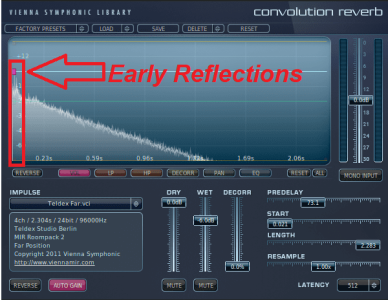
Exactly. Unless they are cut away, there will be always natural early reflections in an impulse response captured in a real room. They are quite easy to spot, most of the time, especially in rooms that have a dense, diffuse reverb tail (i.e. the part that comes after the discrete reflections) like Teldex:

1672600078158.png
Thanks for taking the time to answer! :)

I have just tried separating VSL's Hybrid Reverb to two buses with the "Berlin Stage" preset (Teldex IR) and I get results more similar to the Berlin Studio plugin than with VSS2.
 
I wonder why nobody mentioned that Orchestral Tools recorded most of their libraries in the "wide" position? @Leandro Gardini, great video btw. Enjoyed it.
But Samplicity won't match the dry samples to OT stuff. Unfortunately. Pitty :/
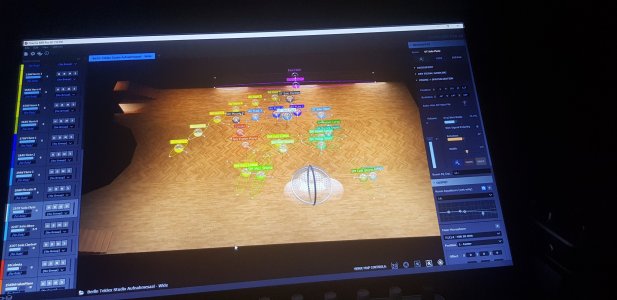
Unless, there is an option to turn the direction 90°. The difference in such is huge. Wide perspective means broader stereo image/less depth. My guess from the videos is, that Ark1 (and that's why everybody likes it and it has a more Abbey Road-ish vibe to it) was recorded in the same situ like the Berlin Studio plugin IRs. Though, later OT changed to the broader perspective. Check Junkie XL Brass Final Epsiode "We have Liftoff!" on YT, where you can see at minute 2:32, Hendrik Schwarzer looking down at the stage and everything is placed 90°. I'm building my new template with MIR 3D which gives me the wide option and it looks something like this atm.
 

Attachments

  • Berlin Studio - The Ultimate Reverb Test
    20230102_010323.jpg
    111.4 KB · Views: 39
I wonder why nobody mentioned that Orchestral Tools recorded most of their libraries in the "wide" position? @Leandro Gardini, great video btw. Enjoyed it.
But Samplicity won't match the dry samples to OT stuff. Unfortunately. Pitty :/
Unless, there is an option to turn the direction 90°. The difference in such is huge. Wide perspective means broader stereo image/less depth. My guess from the videos is, that Ark1 (and that's why everybody likes it and it has a more Abbey Road-ish vibe to it) was recorded in the same situ like the Berlin Studio plugin IRs. Though, later OT changed to the broader perspective. Check Junkie XL Brass Final Epsiode "We have Liftoff!" on YT, where you can see at minute 2:32, Hendrik Schwarzer looking down at the stage and everything is placed 90°. I'm building my new template with MIR 3D which gives me the wide option and it looks something like this atm.

You have a point here! but actually I think the Berlin Studio's main objective is to provide a solution for productions using dry/close miked samples.

I think it's inevitable that its version of the Teldex is not going to sound exactly the same as the ambience in OT instruments. For my own purposes of the few OT samples I do use I may well end up using the close mike versions (if having to doctor the envelope/release samples a little in BOI 2 to achieve this) At least that way everything is dry and can be slung into their appropriate placements on the Teldex soundstage without any noticeable sonic inconsistency.
 
I wonder why nobody mentioned that Orchestral Tools recorded most of their libraries in the "wide" position? @Leandro Gardini, great video btw. Enjoyed it.
But Samplicity won't match the dry samples to OT stuff. Unfortunately. Pitty :/
Unless, there is an option to turn the direction 90°. The difference in such is huge. Wide perspective means broader stereo image/less depth. My guess from the videos is, that Ark1 (and that's why everybody likes it and it has a more Abbey Road-ish vibe to it) was recorded in the same situ like the Berlin Studio plugin IRs. Though, later OT changed to the broader perspective. Check Junkie XL Brass Final Epsiode "We have Liftoff!" on YT, where you can see at minute 2:32, Hendrik Schwarzer looking down at the stage and everything is placed 90°. I'm building my new template with MIR 3D which gives me the wide option and it looks something like this atm.

JXL Brass is the only library recorded in the wide configuration.
 
My understanding is that Berlin Studio IRs were created with OT’s Berlin seating and microphone setup. Not an approximation after the fact, but the same setup.

I think the narrow Teldex seating creates a front to back depth that is one of the key contributors to the Berlin main’s beautiful character.
 
Last edited:
I wonder why nobody mentioned that Orchestral Tools recorded most of their libraries in the "wide" position? @Leandro Gardini, great video btw. Enjoyed it.
But Samplicity won't match the dry samples to OT stuff. Unfortunately. Pitty :/
Unless, there is an option to turn the direction 90°. The difference in such is huge. Wide perspective means broader stereo image/less depth. My guess from the videos is, that Ark1 (and that's why everybody likes it and it has a more Abbey Road-ish vibe to it) was recorded in the same situ like the Berlin Studio plugin IRs. Though, later OT changed to the broader perspective. Check Junkie XL Brass Final Epsiode "We have Liftoff!" on YT, where you can see at minute 2:32, Hendrik Schwarzer looking down at the stage and everything is placed 90°. I'm building my new template with MIR 3D which gives me the wide option and it looks something like this atm.
The recordings for the Berlin Studio IRs were done right after sessions for an Orchestral Tools library.

The microphones were not setup for a "rotated" / wide setting, neither was Orchestral Tools using that approach then, otherwise we would have used it for the IRs, which were also created for Orchestral Tools solo instrument libraries and are included in a number of them.

Maybe more recent libraries have been created with the wide approach, but as far as I know not the original strings, woodwinds, brass, etc.
 
Last edited:
So, Igudesman Solo Violin and Modus are recorded (let me call it) "the long way", and then again Tableau Ensemble Strings are recorded the wide perspective as one can see in the videos.
 
This comment surprised me. Can others comment? I guess I presumed BS could do exactly that; turn a close/spot mic into the sound of tree/main mics (at least—in addition to surrounds,etc.). Or, was this “solved” with the advice from @Peter Emanuel Roos ?


Do you use BS with IB and IW? Do you use the the Studio or … I seem to recall a super dry anechoic type signal well.(?)
This comment stems from my first trying to fatten a super dry close mic French horn signal. My impression was that Berlin Studio can't make up for that kind of lacking in the source signal. At least not without heavy use of other plug-ins. However, this is an almost unfair (and not very practical) test trying to get a dry French horn to sound fat and wet. I have used Berlin Studio with other instruments with great effect, so please don't let this edge case keep you from using or at least trying it. It IS a sensational tool.
 
there are so many ways to combine source and mic positions in BStudio, here's another example of a solo horn; french horns normal position, a bit more of the surround mics and with some direct signal because I like it that way but really one can experiment for hours

View attachment FH-BS.mp3
Thank you, so much more appropriate than my quick and dirty mashup... ;-)

(I don't have a working Daw with access to my libraries at the moment :crying:)
 
  • Like
Reactions: Rob
Back
Top Bottom