×
What's new

Berlin Studio - The Ultimate Reverb Test

What it doesn't do: It doesn't turn a close/spot mic signal into a tree mic signal. I tried it out with Synchron Brass instruments close mic only, it still sounded way too thin. Going in with Tree/main mics produced good results.

This comment surprised me. Can others comment? I guess I presumed BS could do exactly that; turn a close/spot mic into the sound of tree/main mics (at least—in addition to surrounds,etc.). Or, was this “solved” with the advice from @Peter Emanuel Roos ?

I have both. While CRP does a better job of making the dry signal and the reverb gel together vs sounding like a reverb slapped onto a dry instrument than most reverbs do, it does still have that effect to a degree depending on the source signal.

Berlin Studio is a more convincing effect to my ears. The big contributor to this is having three mic perspectives and individual EQ Control per perspective.
Do you use BS with IB and IW? Do you use the the Studio or … I seem to recall a super dry anechoic type signal well.(?)
 
This comment surprised me. Can others comment? I guess I presumed BS could do exactly that; turn a close/spot mic into the sound of tree/main mics (at least—in addition to surrounds,etc.). Or, was this “solved” with the advice from
If that worked nobody would have had to record all those additional mic positions since the invention of IR technology. But that's not reality for reasons like lack of specific room/air interaction with the instruments being recorded.
 
This comment surprised me. Can others comment?
Can't comment on Synchron Brass (since I don't own it), but it's not my experience.
(I've used Berlin with MSB as well as with CineBrass Pro).
However, I prefer using a blend of the reverbed with the direct signal for aesthetic reasons.
 
@Peter Emanuel Roos : maybe this impression is due to the fact that the input doesn't default to 0dB, and a softer signal appears to be "thinner"?

p.s. you asked this in another thread, but I think that maybe it would be indeed a good idea to default the input to 0 dB. (while leaving the "direct" signal as it is)
 
@Peter Emanuel Roos : maybe this impression is due to the fact that the input doesn't default to 0dB, and a softer signal appears to be "thinner"?

p.s. you asked this in another thread, but I think that maybe it would be indeed a good idea to default the input to 0 dB. (while leaving the "direct" signal as it is)
Good point...
Input straight at 0.0 dB and Source at -Inf?
So starting with wet signal(s) only.
Wouldn't that be the best default? Also from a perspective when using it in a Send setup?
Thanks
 
Thanks, if it’s a matter of input/source settings (whatever the defaults) then I’ll be able to work with it. Still interested in getting this (BS) at the intro price, because I love the Teldex sound. It definitely seems like the ultimate model for convo verbs.
 
Also if you have a thin sounding close mic the body is simply not there and was never recorded to begin with. If you reverberate/filter that signal with another mic position via an IR it won't reappear magically.

Edit: I may just stated the obvious. If so, sorry.
 
Last edited:
Do you use BS with IB and IW? Do you use the the Studio or … I seem to recall a super dry anechoic type signal well.(?)
Still trying to figure out a good approach for using it with the Infinite Series. So far it seems to do better with the Studio environment versus completely dry.

The woodwinds seem to be better in situ since the woodwinds IR in Berlin Studio is shared across all instruments.

Whether close mic only or mic mix 1 works better is still with the eggheads down in the lab.
 
Also if you have a thin sounding close mic the body is simply not there and was never recorded to begin with. If you reverberate/filter that signal with another mic position via an IR it won't reappear magically.
This is true. The success depends on the quality of the close mic signal. If it's well recorded it will work well. But some sample libraries have close mics but the sample libraries were never intended to be used solely as close mics, they're meant to be blended with the tree mics. For example, Cinematic Studio Brass, if you use solely the close mics, you'll get a more thin sound. If you use only spot mics on a string library, you'll end up with way more rosin sound.

If you go in thinking you can just use close/spot mics from orchestral libraries with Berlin Studio I think you're not using this in the best way. The best application is for dry instruments that were purposely well recorded dry and not recorded on a scoring stage. For me, that's things like solo woodwinds, solo strings, percussion, guitar, etc.
 
I agree. Another way to look at this is that sample devs could develop a recording/miking method optimized for specific IR sets. Maybe VSL is doing that already!? Anyhow taking random close mics will mostly not work.

Edit: I have doubts that will work that good with brass especially. I mean is there a brass library with close mics which work on their own?
 
Last edited:
Edit: I have doubts that will work that good with brass especially.
I agree.
With the brass libs I use (CineBrass, MSB as well as Century Brass) I see no reason to use the close mics only. With those, I completely mute the AB-Mic in Berlin, and adjust the Decca and Surround to the direct signal (which is the mic mix coming out of Kontakt).

But in the case of MSS I prefer using their close mics only (plus Soothe), since unfortunately I really struggle with the room tone of that library.
 
sample devs could develop a recording/miking method optimized for specific IR sets. Maybe VSL is doing that already!?
Yes, that's what VSL did. The raw MIR concept dates back to 2002, it was an integral part of the whole idea Vienna Instruments are based on from the very beginning.

Synchron Series are a different beast, of course.
 
This is true. The success depends on the quality of the close mic signal. If it's well recorded it will work well. But some sample libraries have close mics but the sample libraries were never intended to be used solely as close mics, they're meant to be blended with the tree mics. For example, Cinematic Studio Brass, if you use solely the close mics, you'll get a more thin sound. If you use only spot mics on a string library, you'll end up with way more rosin sound.

If you go in thinking you can just use close/spot mics from orchestral libraries with Berlin Studio I think you're not using this in the best way. The best application is for dry instruments that were purposely well recorded dry and not recorded on a scoring stage. For me, that's things like solo woodwinds, solo strings, percussion, guitar, etc.
THIS!... I use Chris Hein for all my main woods/strings/brass orchestral instruments: the samples are all recorded bone dry so I suspect this plugin will be perfect for my symphonic mock-ups.

For percussion I use CinePerc close mic samples. I do occasionally use the flautando and pizzicato from OT Berlin Inspire 2 and very occasionally the rhythmic strings/choirs from Time Macro/Micro. I imagine I could match the OT baked in Teldex from BOI and leave the ambient mics in place from TM and get a much more realistic blend with CH/CinePerc using Berlin Studio.

For the last few years I've been bussing each grouped orchestral section to Logic's Space Designer reverb which is pretty decent but of course is algorithmic in nature without any placement features let alone custom instrument reflection!

Sometimes everything marries together well after judicious balancing of section send levels/eq and overall reverb level, giving a passable feeling of sitting in front of an orchestra in an auditorium as I imagine any other algorithmic reverb or single IR convo verb would do to a lesser or greater degree.

However the key difference to gaining that extra realism as far as traditional orchestral production is concerned with Berlin Studio is that detail of the individual placement and its actual reflective result in that particular respective instruments seating area on the soundstage can never be replicated in any conventional reverb plug in. That's the big difference here and precisely what Daniel James pointed out in his video on BS.

I'm sure the developer will agree that his own Bricasti reverb, all be it one with its own high quality flavour, is no different in this respect from any other reverb out there.

It certainly looks like Berlin Studio will push the envelope to a more realistic, exciting orchestral sonic. For me if this is the case that extra realism/detailed ambient polish is a worthy thing to have especially when it comes to presenting new orchestral work to classical label execs!
 
Any comparison to the good ol VSS2?
Ok, so here's an attempt by me.
First and third examples are VSS2+VSL's Convolution Reverb. The second and fourth are Berlin Studio. I'm using the VSL Synchronized Special Edition plus Triple horn (with the unprocessed, original signal).

Imho Berlin Studio has a more "realistic" effect on horns. I'm sure it's possible to get closer to that with VSS2+reverb, but I like the almost-instant result with BS. It's more intuitive to me to mix with the signals.

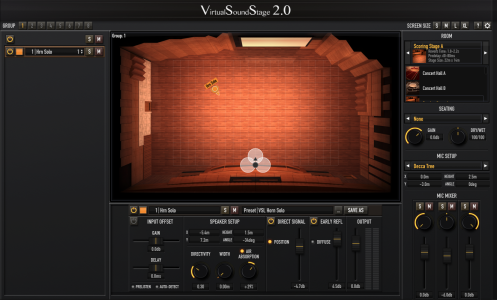
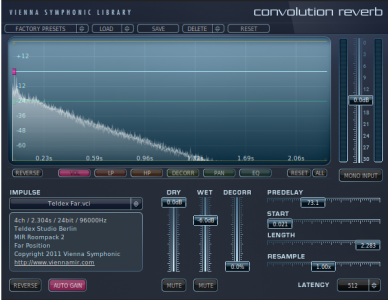
Here's my settings for VSS2+reverb:
Berlin Studio - The Ultimate Reverb Test

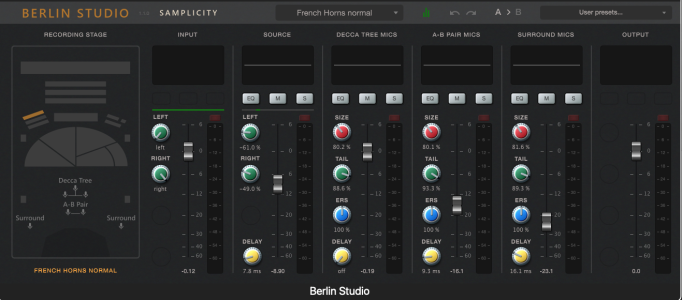
...and for Berlin Studio (note that I've reduce the size and tail a bit):
Berlin Studio - The Ultimate Reverb Test
 

Attachments

... so you put natural ERs on top of artificial ERs ...? Hmmmm.

I assume you mean that there's an ER part of a convolution reverb then? I didn't know that. Thanks for the input. I'm a classically trained composer, and unfortunately mostly self-taught when it comes to mixing and how reverb works. This kind of makes me more convinced Berlin Studio is better for me. Less chance of screwing stuff up. But it also makes me wish even more I had a second degree in sound engineering...

Here's another attempt, using VSS2 + VSL's Hybrid reverb with a Scoring Stage preset with the ER turned off.
 

Attachments

Back
Top Bottom