Rubens Tubenchlak
Member
Me too!Listening from the phone - I like this one the most!)

Me too!Listening from the phone - I like this one the most!)

There are complete Venue Presets for more than half a dozen Venues, with so-called "Roles" for each individual Dimension instrument as well as the respective ensembles as a whole. (However, I suggest to replace the legacy "MIRx"-type 1st-Order Output Setup for the Main Microphone with one that uses the possibilities of HOA, e.g. "Stereo - MIR 3D HOA Downmix" from 7.1.2).Dietz,
could you share the best practice for that example, using dimension strings (besides going for the HOA mics)?
Yes, leaving these two parameters "off" can be considered the typical use case. Especially using the Directivity Filter for the dry signal is comparable to turning an instrument away from an otherwise perfectly positioned spot microphone. (... of course, the directivity filter will always be "on" for the sound radiation of the source into the room, unless you assign an "omni" shaped "General Purpose" Instrument Profile). - Air Absorption simply rolls off the upper frequencies depending on the distance between the source and the Main Microphone. This can sometimes help to differentiate between similar-sounding instruments, but it's by no means a must; you wouldn't do this with spot mics from a real recording in most cases either.Are you suggesting as well to turn off Air Absorption and Directivity Filter or have I got it wrong?


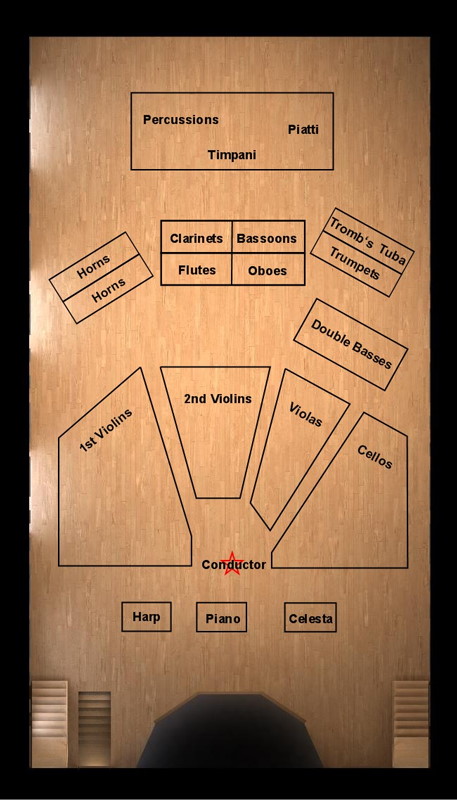
Of course not. There is not one single "typical" seating scheme. When we recorded Teldex Studio for MIR Pro back in 2010 or 2011, the senior staff provided us with the following "typical" setup:the presets in MIR don't match the typical position/seating of the instruments that the OT libraries

Hmmm .... are you sure that the Secondary Mic shows this format? Usually the Secondary Mic serve very special purposes in MIR Pro, hence its specific Output Formats.Dietz,
When I connect my DAW to MIR Pro 3D, the secondary microphone is set to the "Stereo - MIR 3D HOA DnMx" format by default. But why does this format not appear in the Edit Output Format Window for Secondary Microphone when I open it? It only appears in the Edit Open Window for Main Microphone.

Yeah, i am using the VSL site to help me better understand MIR, since, when i decided to try it out, that since the site always has so much documentation about pretty much anything (from the VSL VI to orchestration) i figured it would have a lot of stuff about Mir as well (i also looked, and i am stil looking at various videos on the vsl channel to learn even more).Of course not. There is not one single "typical" seating scheme. When we recorded Teldex Studio for MIR Pro back in 2010 or 2011, the senior staff provided us with the following "typical" setup:
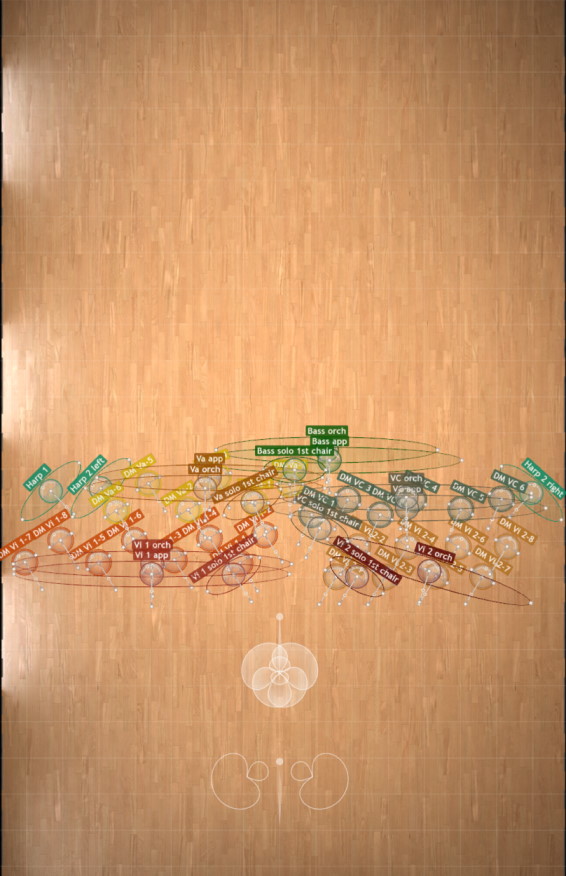
... but then, there are many occasions where it's preferable to have the 2nd Violins on the right, opposing the 1st, and the basses closer to the center axis, which led me to the following suggestion for MIRx (now included as "Vienna Standard" in the factory settings of MIR 3D):
(... scroll down this page for the other instrument families.) Should be not too hard to take it from there, if you like or need other setups.
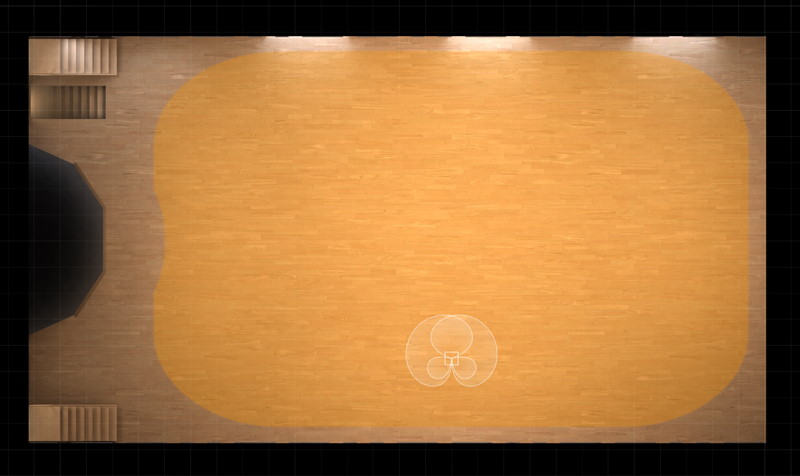
I for one prefer the "landscape" orientation for modern scoring anyway. The "portrait" setups shown above tend to be a bit narrow, especially in stereo - hence the inclusion of the so called "wide" version in MIR:
(... the yellow-ish overlay depicts the "allowed" area for signal sources.)
HTH!
Hi Nashi,Yeah, i am using the VSL site to help me better understand MIR, since, when i decided to try it out, that since the site always has so much documentation about pretty much anything (from the VSL VI to orchestration) i figured it would have a lot of stuff about Mir as well (i also looked, and i am stil looking at various videos on the vsl channel to learn even more).
I was just commenting on the fact that trying to match the sound you would get with Orchestral Tools's libraries and with libraries passed throught Berlin Studio, with libraries passed throught Mir Pro with Teldex can be decieving, since Orchestral Tools usually has similar seating positioning for most of their libraries (the Arks and the Times are some of the exceptions because of the different sizes of the sections recorded), and the people at Samplicity claim to have the same set up of mic that Orchestral Tools use for their recordings, so the instruments match their sound and positioning very well, also i do agree that Teldex sound very good in "landscape", but, once again, i have never seen Orchestral Tools record that way. (maybe they did with some library i am not sure)
So, all in all, my post was just about the side by side comparison, not the quality of the sound or the plugins themselves.

I for one, think this is a very difficult comparison to make because MirPro is so entirely configurable and flexible, BS pretty straightforward, it is what it is, but with MirPro being so flexible...how would expect to objectively compare them? You can most likely be making apples to oranges comparisons very easily regardless of the fact that you use Teldex room in both cases. From what I have heard, they can both sound great in the hands of the right user.Hi Nashi,
are you planning to provide a fair comparison between MIR 3D and BS?
Curious about your findings so far.
yeah, as @Dewdman42 said, and what i was also implying with my posts, was that comparisons are pretty hard to make, one would be very good at MIR PRO (i am not) to be able to, first of all get the instruments in the right positions as they were recorded in BS (or in the Berlin Series for example), then there is the issue of the mic positions, i think that the "easiest" way would be to just compare the Decca Tree and nothing else, but with MIR you can for sure "fake" or replicate the other mic positions with how much control you get with the plugin, however, it would require a lot of guess work, a lot of tweaking and knowledge of MIR istelf and also a very good pair of ears, to even try to accomplish that.Hi Nashi,
are you planning to provide a fair comparison between MIR 3D and BS?
Curious about your findings so far.

lol, the point of Berlin Studio is exactly that it's not just the Decca Tree, so why would one make a comparison that leaves out the core of the concept of the plugin in question?i think that the "easiest" way would be to just compare the Decca Tree and nothing else
That is exaclty the point i was trying to make with all of my messages.......... to make the comparison "fair" it would either take a lot of time, effort and expertise, or it would be "just" a lower effort one with only the Decca Tree (and, as i said in my various posts about it, even that would take a lot of time and guess works sice you would need to emulate the actual seating positions of the BS/OT recordings).the point of Berlin Studio is exactly that it's not just the Decca Tree, so why would one make a comparison that leaves out the core of the concept of the plugin in question?
Sorry for the misleading. Maybe the comparison term isn't appropriate, especially if you take it literally.I for one, think this is a very difficult comparison to make because MirPro is so entirely configurable and flexible, BS pretty straightforward, it is what it is, but with MirPro being so flexible...how would expect to objectively compare them? You can most likely be making apples to oranges comparisons very easily regardless of the fact that you use Teldex room in both cases. From what I have heard, they can both sound great in the hands of the right user.
For me, it does not matter the technicality at all. My concern is only with which one I can get the best results.
I disagree with such a categorical statement that BS has more depth or more energy. Based on what? MirPro is very configurable and flexible. That user was apparantly not able to get as as much depth and energy as BS; according to them. it is not objectively honest to categorically say that MirPro has less depth or energy then BS.As Nando pointed out, about the Psycho mockup, with MIR it seems you get a better stereo field image, with BS more depth, and more "energy". From that, any MIR 3D user could propose objective directions to add depth and energy to the mockup without losing the stereo field image?

You certainly haven't seen it decades ago. I made it myself recently, and extensive attention was paid both to the markings in the score and the bowing used by the orchestra whose video it was originally synched to.Not relevant, but please let me get this off my chest: That the MIDI performance here is horrible, no attention was paid to legato or detaché. I believe I have seen this MIDI file before, decades ago on the web, so this is not the fault of the kind soul who uploaded these tests.
You could also ask why modern orchestral recordings are done the way they are done, with a multiple mic setup, instead of just capturing the orchestra with one stereo microphone from one position.I disagree with such a categorical statement that BS has more depth or more energy. Based on what?
)
Tom Holkenborg Brass was recorded in the wider arrangement. Also it looks like Ark Zero as well, based on this video:i have never seen Orchestral Tools record that way. (maybe they did with some library i am not sure)
You could also ask why modern orchestral recordings are done the way they are done, with a multiple mic setup, instead of just capturing the orchestra with one stereo microphone from one position.
The strength of Berlin is exactly that it lets you work with samples as if you would record an orchestra, thus providing energy, a detailed sound and yet lots of depth. (have I mentioned that I love this reverb?